
Standards and procedures should be simple yet effective. They lower frustration, create a better environment for your team to succeed and give your customer a better and more consistent product. In fact, one of the most important byproducts of standards is consistency. Let’s say you are a machinist that works from engineering drawings to machine parts. Without engineering drawing standards, it is possible, and likely, the format and layout will be different from one drawing to the next. This will require time to study the drawing to find the information, assuming the information exists. Let’s also imagine there arent design standards that account for a design for manufacturability. The machinist is not able to work efficiently, and the whole process is error-prone. This is engineering to manufacturing example, but the same is true for any information moving through the company.
I was very lucky fresh out of college when I started my career at a company that had been around for 50+ years at that point and had well-established and well-enforced standards. Their standards were based on industry standards and were not optional. When you started at the company, there were weeks dedicated to training for their standards and how they conducted business. I was in the engineering department, but I learned this was standard operating procedure for all departments.
All staff was trained for their department. Once you got the hang of how the company conducted business, you didn’t think much about standards and procedures unless helping someone new get up to speed. There also seemed to be a sense of freedom, speed, and enhanced creativity due to focusing on your work and not how you were supposed to move forward. Departments and their staff, both upstream and downstream from your department, knew they could expect consistency from other departments, and it was clear what was expected from them. Although I wasn't there when our product was delivered and installed for the customer, I assumed they were pleased. I know we had a good reputation in the field. This company had a strong commitment to standards and procedures, and it paid off.
Following my time there, I saw varying degrees of success with standards and procedures at other companies. I have seen those that didn’t bother. The task of getting that in order was too daunting for them. I have seen other companies make a good run at it but become frustrated because no matter the level of effort or number of tries, nothing seemed to work. In both cases, efficiency, consistency, mural, and their clients suffered.
As I moved into management, I felt obligated to my profession, my company, and all of the employees (especially those reporting to me) to be committed to good standards and procedures. As a manager, I feel that it is my responsibility to create an environment where people can succeed. There is no better place to start than with standards and procedures. To me, it is like a team’s playbook. All players on the field need well trained in their position, know the plays, and execute those plays as efficiently as possible.
Success on this subject can be measured and defined in many ways, but this is how I see it.
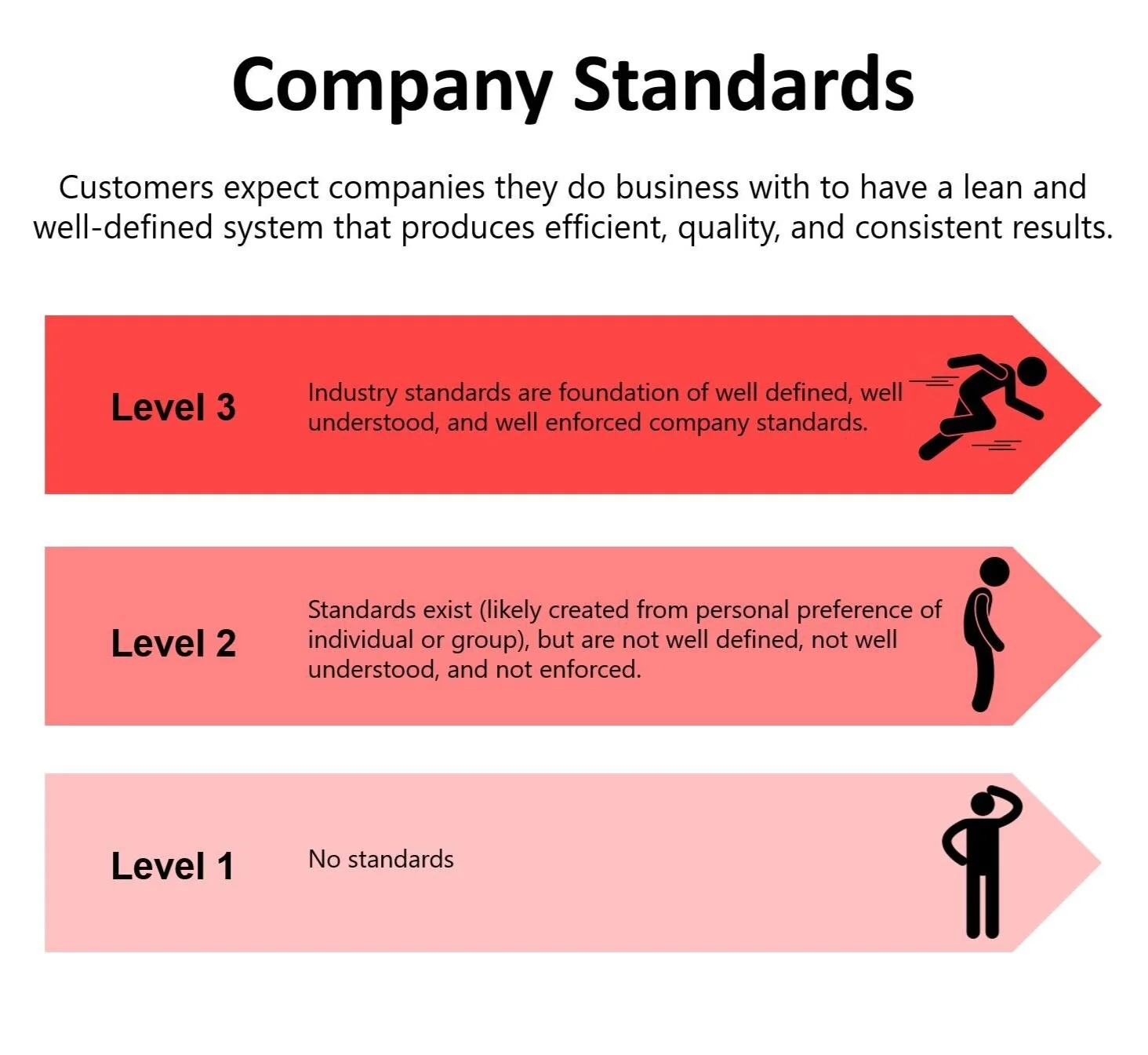
Level 3:
Congratulations! You know the benefits and that it is worth the effort to get there and stay there.
Level 2:
You are on the right track! If you are putting forth any effort to get things in order, you must want it to happen, and you deserve to get there.
Standards and procedures should be based on industry standards. They can be adjusted for your company, but start there. If they are based on someone’s personal preference or their next great idea, you will want to redirect. There are many smart and dedicated people who try to help and often fill a void, but if they lack the knowledge and experience, they may be digging a deeper hole. This is unfortunate because you don’t want them to become discouraged, but more importantly, you don’t want to lead the company further down the wrong road.
Someone needs to be in charge of leading the effort to get to the next level. Even if there is more than one department involved, there needs to be someone at the helm. There are some significant things to keep in mind for this person. They need to be a leader, knowledgeable, experienced, committed, and above all else, have the authority to make decisions and hold teams accountable. Without that, it will be challenging for them or the effort to be successful.
Level 1:
Getting to level 3 is achievable, and it is worth the effort. There have been so many times in my career that I have heard, “this has been attempted, and it will not work.” This is not true. If it is attempted without the correct motivation, direction, and leadership, it will likely fail. However, done correctly, there is no doubt you will succeed in getting there.
In my experience, the fear of having standards and procedures is due to misunderstanding them. Some things that I have heard and seen:
“They are too rigid and will stifle creativity”: The opposite is true. Good standards and procedures open increase productivity and give teams a firm foundation to conduct their work.
“They are too confusing”: Good ones should be easy to follow.
“My way is working”: I have heard this one many times, and the first part of my answer is, there isn’t a “my way,” especially if it is not serving the company well. There is only “our way.” The second part is, if “your way” is working, then let’s make it “our way.” If it isn’t, we will be moving in another direction.
Companies don’t know where to start: Start with industry standards and go from there. Change as little as possible to meet your companies' needs and make sure what is changing will not negatively affect the company.
